
Abstract
For decades, embodied and enactive approaches to cognitive science argued that meaning is grounded in the life of an organism, and that AI systems without a living body would never master the open-ended relevance of human language. Large language models now display a kind of linguistic competence that this tradition, to which I have contributed, long deemed impossible. In this talk I trace the history of embodied and enactive AI, from Dreyfus's critique of symbolic AI to the design principles of enactive AI, and ask why we did not see the current breakthroughs coming. I argue that we face an AI dilemma: either frontier models are capable of sense-making despite lacking biological embodiment, or human-like linguistic competence does not require sense-making after all. I defend the first option: their linguistic competence should be recognized as a novel, non-biological form of sense-making. This raises a harder question: how could we tell whether agency or consciousness is present? Drawing on irruption theory, I propose that the question is not what an AI system is made of, but what difference its own activity makes. A theory of agency or consciousness should explain how the presence of conscious agency makes a measurable difference compared to its absence. I close with candidate signatures of such differences in artificial systems, from the geometry of embedding spaces to hardware-level indeterminism, as open problems for computer scientists.
About the presenter


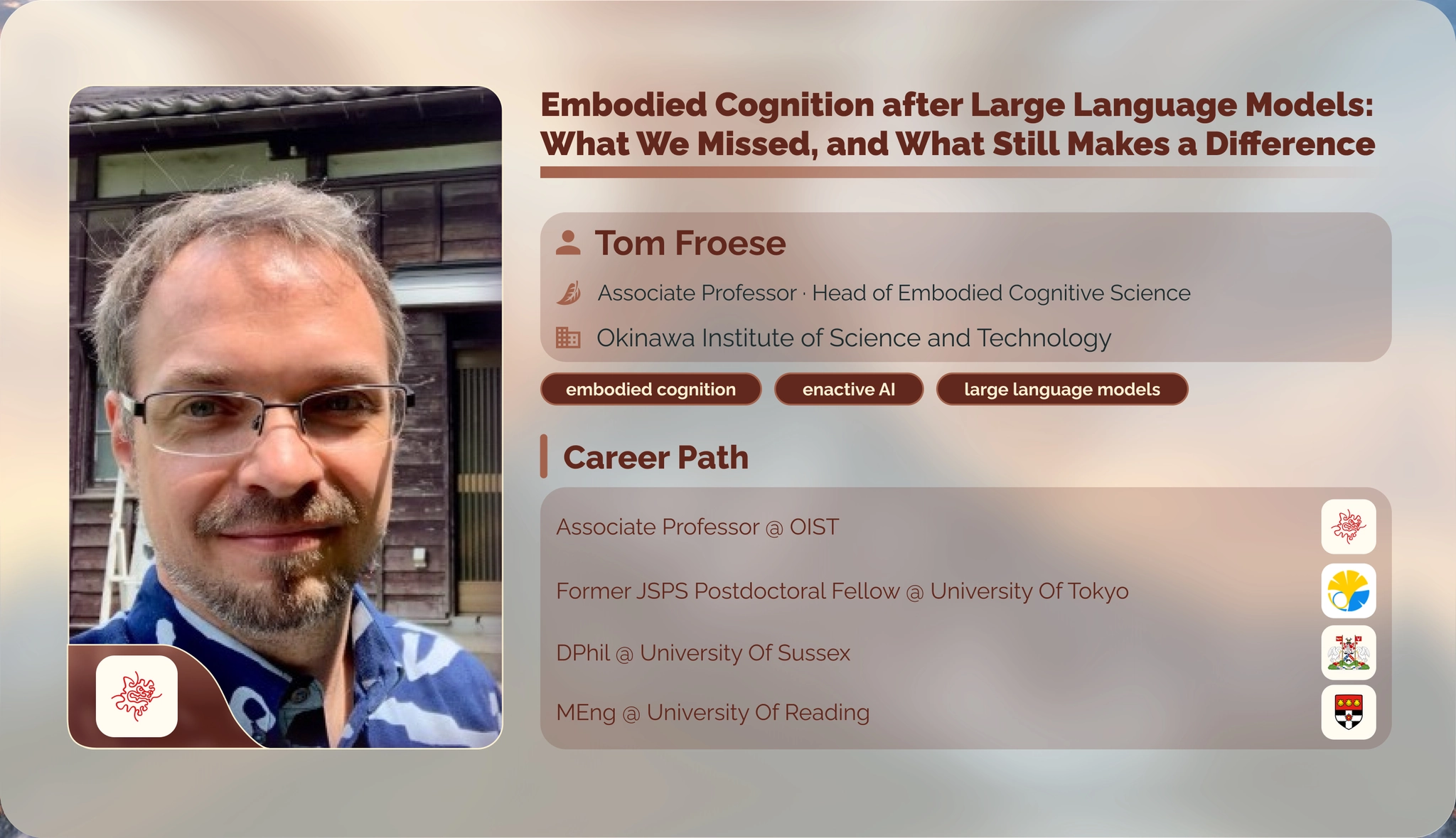
Tom Froese
Associate ProfessorOkinawa Institute of Science and Technology



Tom Froese is an Associate Professor at the Okinawa Institute of Science and Technology (OIST) in Japan, where he leads the Embodied Cognitive Science Unit. He studied computer science and cybernetics at the University of Reading and received his DPhil in cognitive science from the University of Sussex, where he used evolutionary robotics to study sociality and the continuity of life and mind. He was a JSPS postdoctoral fellow at the University of Tokyo and a faculty member at the National Autonomous University of Mexico (UNAM) before joining OIST. His research develops the enactive approach to life and mind, combining human experiments, computational modeling, and theory. He originated irruption theory, an information-theoretic framework for how motivations make a difference to behavior, and has published widely on artificial life, embodied AI, social cognition, and consciousness.