
Abstract
AI is often described as the fourth technological revolution, following the agricultural, industrial, and internet revolutions. However, beyond its technological impact, AI also represents a fourth major decentering shift in human history. After Copernicus displaced humans from the center of the universe, Darwin from the summit of biological life, and Freud from the center of the mind, AI now challenges humanity’s presumed monopoly on intelligence. By examining AI through historical, philosophical, technological, and societal lenses, this research (co-authored by Nobel Laureate Geoffrey Hinton) explores the rise of cognitive decentering and its implications. More info at https://link.springer.com/10.1007/s12559-026-10569-8
About the presenter


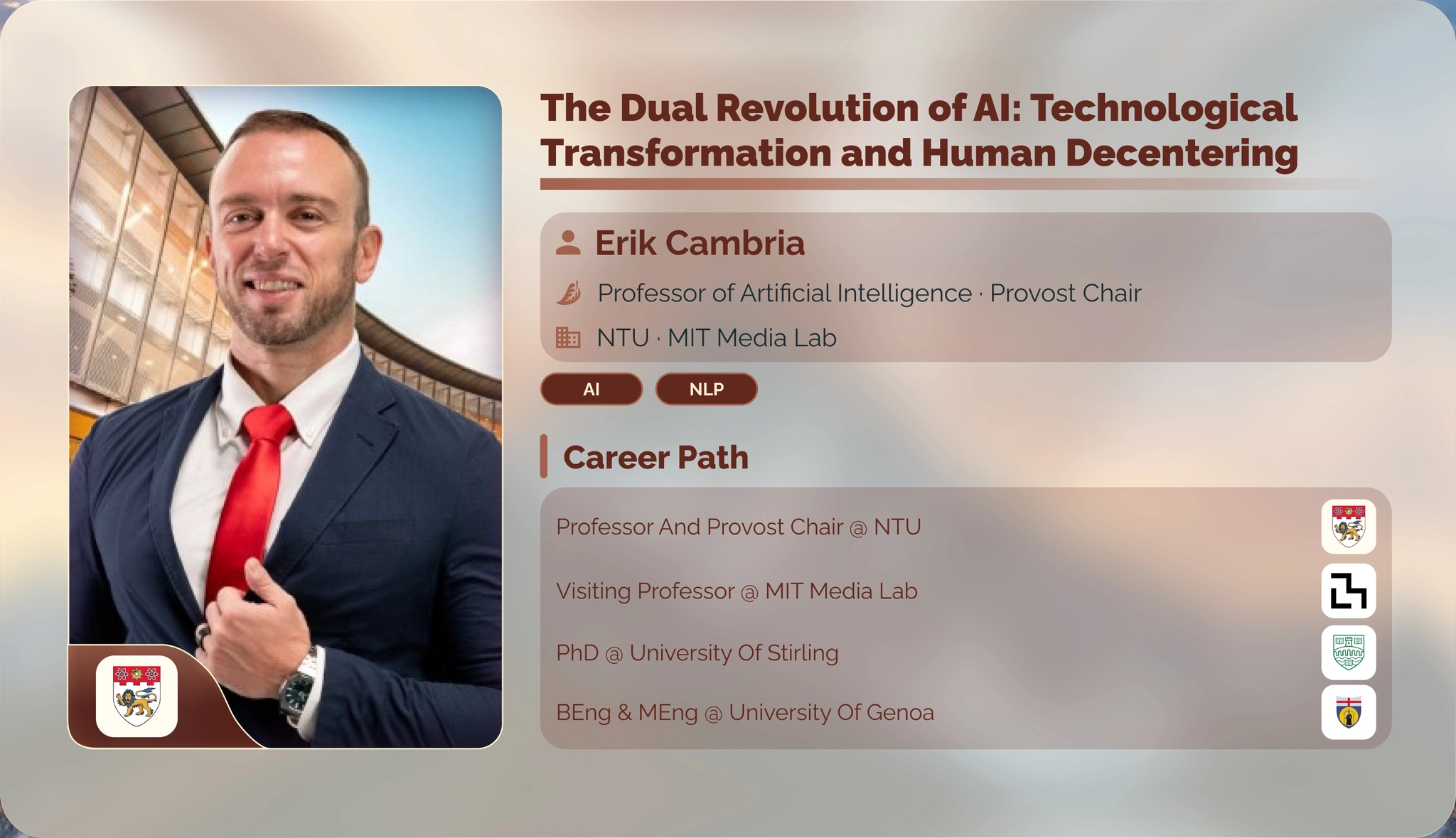
Erik Cambria
Professor of Artificial IntelligenceNanyang Technological University



Erik Cambria is a Professor of Artificial Intelligence at NTU CCDS, where he also holds the appointment of Provost Chair in Computer Science and Engineering, and a Visiting Professor at MIT Media Lab. He has founded several AI companies, such as SenticNet, offering B2B sentiment analysis services, and finaXai, providing explainable financial insights, and has worked at HP Labs and Microsoft Research prior to joining academia. Today, his research focuses on XAI, neurosymbolic AI, multimodal interaction, affective computing and sentiment analysis, in domains like healthcare, finance, climate, and education. Prof Cambria is ranked in Clarivate’s List of World’s Top 1% Scientists since 2022, is recipient of many awards, e.g., AI’s 10 to Watch, and was featured in Forbes as one of the Five People Building Our AI Future. He is an IEEE Fellow, Associate Editor of various top journals, e.g., IEEE Transactions on Affective Computing, and is involved in several AI conferences, e.g., AAAI and ICLR.